Your $30 Jacket Actually Costs More Than My $100 One
Remember that cheap coat you bought last winter because it was on sale?
The one that’s already falling apart?
Yeah, I’ve been there too. We all have.
I used to think I was being smart with money by always going for the cheapest option. Turns out, I was doing the exact opposite. And the math behind it is painfully simple once you actually see it.
Why Your “Deals” Might Be Costing You
Here’s the thing about cheap stuff. It breaks.
And when it breaks, you buy it again. And again.
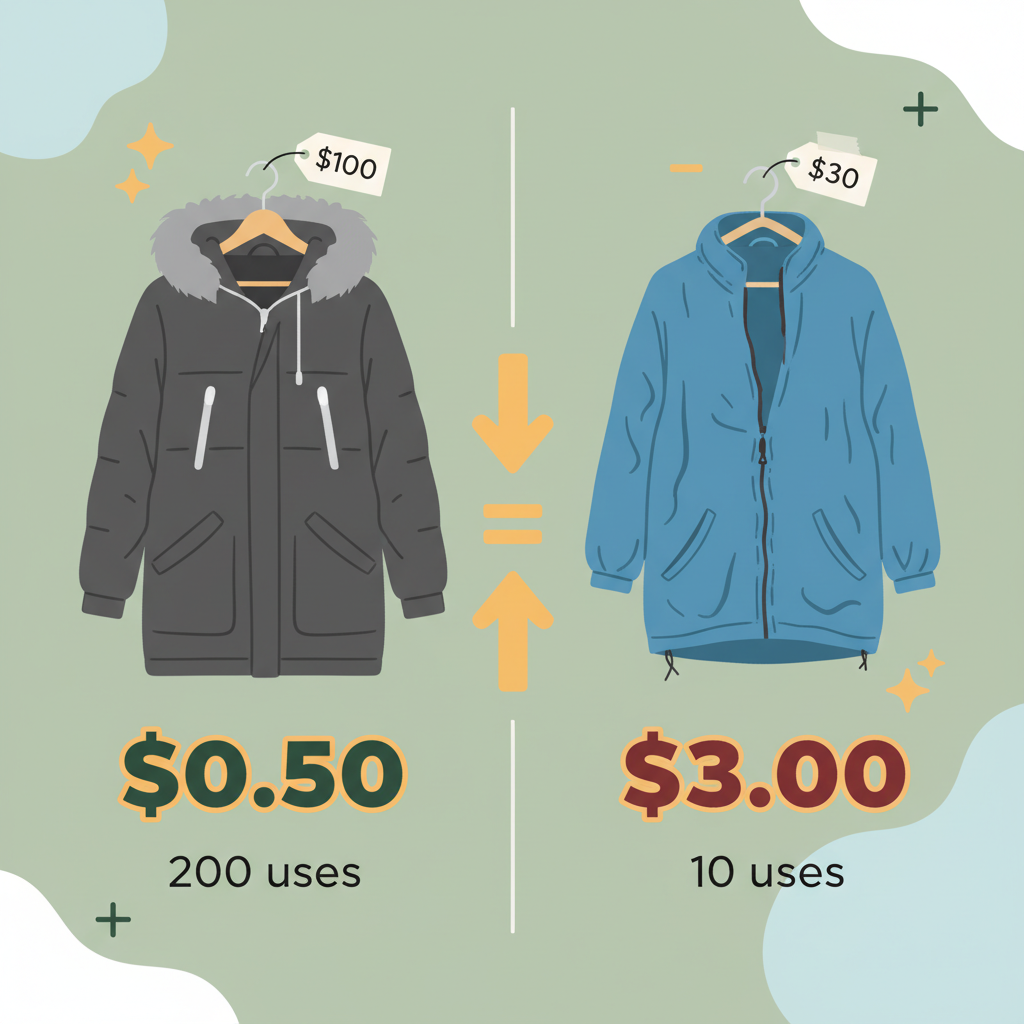
My old shopping habit looked like this: Buy a $30 winter coat because it’s “such a good deal.” Wear it maybe 10 times before the zipper breaks or the fabric starts looking rough. Then back to the store for another “deal.”
Do the quick math with me here.
That $30 coat worn 10 times? You paid $3 every single time you put it on.
Meanwhile, my friend bought a $100 quality coat five years ago. She wears it twice a week during winter months. That’s about 200 wears so far, and it still looks great.
Who’s actually being cheap here?
The Tool That Changed How I Shop
After one too many “bargain” purchases that ended up in the donation pile, I created something to stop myself from making the same mistake over and over.
It’s called the Price-Per-Use Calculator, and honestly, it’s saved me from countless regret purchases.
You punch in three simple things:
- What you’re thinking about buying
- How much it costs
- How many times you’ll actually use it
Then it shows you the real cost.
Not the price tag cost. The actual, per use cost that tells you if something is worth your money.
When Expensive Actually Means Cheaper
Studies show that people only wear clothing they’ve bought about seven times before tossing it.
Seven times!
That’s heartbreaking. For your wallet and the planet.
But here’s what happens when you start thinking in cost per use instead of sticker price.
Let’s say you’re choosing between two pairs of jeans:
Option A: £30 trendy jeans from a fast fashion store. You wear them twice, then they sit in your closet forever.
Option B: £210 quality jeans that last five years. You wear them twice a week. That’s 520 wears, plus maybe one repair for £25.
The “expensive” jeans are actually 33 times cheaper every time you wear them.
That’s not even counting the mental energy of constantly shopping for replacements or the frustration when cheap stuff breaks.
How to Actually Use This Thing
The [Price-Per-Use Calculator](link to your tool) works for way more than just clothes.
I’ve used it for:
- Kitchen appliances (is that cheap blender really saving me money if I replace it every year?)
- Gym memberships (am I actually going enough to justify this?)
- Tech gadgets (will I use this tablet daily or will it collect dust?)
- Furniture (that IKEA chair vs the quality office chair debate)
You’re probably thinking: “But I don’t know how many times I’ll use something.”
Fair point.
Start by being honest with yourself. Think about similar items you already own. How often do you actually use them?
That gym bag you bought? Still has tags on it? Yeah, the next one probably won’t be different unless something changes.
The coffee maker you use every single morning? That’s worth investing in because your cost per use drops with every cup.
Quality Doesn’t Always Mean Expensive
Here’s where it gets interesting.
Quality items often cost less than buying cheap repeatedly, but you don’t always need to buy brand new.
Secondhand quality beats new cheap almost every time.
A used premium brand coat for $50 that lasts you five years? That’s better math than a new $30 coat that lasts one season.
The calculator doesn’t care where you bought it. It just shows you the truth.
The Real Cost of “Just $5”
Ever notice how marketing tries to break everything down into tiny amounts?
“Just $5 a day!”
“Only $2 per serving!”
They’re using the same math we are, just backwards. They want that number to look small so you don’t think about the total.
But when you flip it around and look at cost per actual use, the picture changes completely.
That subscription you barely use? That’s not $10 a month. If you only use it twice, that’s $5 per use.
The streaming service you forgot you had? Infinite cost per use if you’re not watching anything.
What Actually Matters Here
Look, I’m not trying to convince you to only buy expensive things.
That’s not the point at all.
The point is knowing the difference between a good deal and a bad one.
Sometimes cheap IS the right choice. If you need something for a one-time project, who cares about durability?
But for things you use regularly? For items that are part of your daily life?
And now you have a tool to prove it before you buy, not after you regret it.
Try It Before Your Next Purchase
Next time you’re about to click “add to cart,” do this:
Open the Price-Per-Use Calculator.
Punch in the numbers.
Be honest about how many times you’ll actually use it (not how many times you wish you’d use it).
Look at that cost per use number.
Does it still feel like a good deal?
Then make your choice with actual information, not just hope and marketing tricks.
The Bottom Line
Here’s what changed for me.
I buy less stuff now. Way less.
But what I do buy? I actually use it.
My closet has fewer items, but I wear everything in it. My kitchen has fewer gadgets, but they all earn their space.
And somehow, despite buying “expensive” things, I’m spending less overall.
Because I’m not constantly replacing broken cheap stuff.
That $100 coat worn 200 times beats a $30 coat worn 10 times.
Want to see the real cost of your next purchase? Try the Price-Per-Use Calculator and stop falling for fake deals.
Have you ever calculated cost per use before buying something? What surprised you most? Drop a comment below. I’d love to hear about your “cheap purchase that cost way too much” stories.